Thursday, October 1, 2015
Over the border to Bolivia
24 September
Cruz del Sur bus, Puno to Arequipa
Weather gods normally smile upon us when we travel. Not so yesterday. We had booked an afternoon tour to Sillustani to visit the tower tombs. It had been a beautiful morning, but by the time we left Puno, thunder clouds were on the horizon. We threw in an umbrella and a poncho just in case and headed off with a jolly crew of Korean Americans and assorted others. By the time we reached the site, the sky was a nasty mix of green and black. Had we been on our own, we would have run around the towers, fired off a few happy snaps and grabbed the first bus out of town. We were trapped!
Our guide insisted on giving us the full routine, even as the wind reached gale force and the rain began to fall. The crafty Koreans managed to detach themselves and, unnoticed, bolted back to the shelter of the bus. Paul's souvenir cap flew off over a cliff as the temperature dropped to near zero. Amongst the asorted others were a couple of Polish girls, who had come well equipped for such a major weather event. They looked like they had just stepped out into a Warsaw blizzard by the time they had layered up. All we had were light jumpers. At the third "stop for informations", we followed the Koreans' example and headed off at top speed to the bus. We did learn a few things about the tomb towers, including the surprising fact that the Incas only used the site for just over 80 years, until the Spanish invasion. Earlier cultures had used similar towers for burials for up to 700 years prior to the Inca Period. To top off the day, Paul's errant cap was returned by our ever-watchful bus driver who must have seen it sail off the cliff.
All the guide books will tell you that there isn't much to Puno other than the floating islands of Lake Titicaca. Having spent the best part of two days strolling up and down Ave Lima, the main street, we would have to agree. But if you look hard enough there is nearly always something going on in a Peruvian towns. At 10am on our last day, with time to kill as our bus was to leave at 3pm, we spotted a group of MPs and a group of fully kitted-out modern day Peruvian warriors. Further examination revealed preparations for a military parade. We are becoming big fans of South American military parades. We took up front row seats on the edge of the main square with a couple of dozen other retired locals and took in the whole performance, from the arrival of various pieces of equipment, to the careful arrangements of that equipment, through to the removal of that equipment all together. And that was before the Main Event! More military arrived, groups of Indigenous in traditional dress lined up and the excitement built as the band could be heard warming up on a side street. Not all went to plan though as we were shooed off our front row seats by a baton-wielding lady soldier. Not at all phased, we took up lower quality seats on the steps of the Cathedral with the locals. What a show! Led by a large group of pre-school kids done up as angels, the parade was on. Altar boys and girls, incense-dispersing priests and the statue of the Virgin Mary on a plinth, held high on the shoulders of soldiers.
The now-familar Peruvian national anthem was cranked up, the crowd stood, including us, hats off, hands on hearts rifles at "present arms", hundreds of military singing along with "mucho gusto". We all finished off with a resounding "Viva Peru"! The parade pressed on up the main street with school children, more local cultural groups and, of course, the soldiers. What a way to kill a few hours.
There was a very interesting cultural lesson about Peru in all this. There was a strong message in all we saw. The military ran the show, but the church, the local community and indigenous groups all played a part. Given that the celebration was a religious feast day, the leading role of the military would seem out of place in most countries. Not in Peru!
Another interesting observation is that Peruvian cultural heritage is "cool". The biggest thing among teenagers seems to be traditional dancing and music. It is fairly common to see large groups of kids practising traditional dance in town squares. Groups of teenagers, mostly boys, gather on corners playing traditional tunes. Groups of girls hang about, just listening of course.
25 September, Casa Tintin,
Arequipa
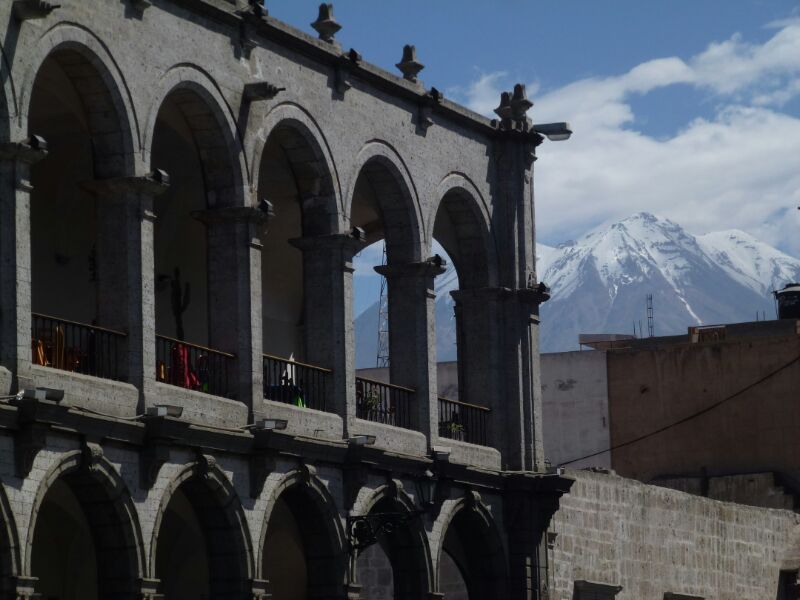
Despite the rather odd name, our Tintin hotel is really very nice, situated in a secure residential area with a fantastic view of the snow-capped volcanoes that surround the city. Arequipa is the second largest city in Peru, but at around 1 million people, it is dwarfed by Lima with almost 9 million inhabitants. We did a fair bit of walking around the city and inner suburbs today and were very impressed. Like most towns and cities in Peru, Arequipa's streets are extremely clean, if a little delapidated in places. It is just amazing how little litter there is, even in small villages. People seem to take responsibility for their own footpaths, constantly sweeping and washing away the dust.
Arequipa's main plaza is just beautiful. A creamy white stone is used through most of the central city and with the bright sunlight and brilliant blue sky today it was just a picture. Sadly, the Cathedral that runs the length of one side of the plaza was covered in scafolding. We only have one day here and a lot of today was spent chasing up tour companies for our trip through Colca Canyon. Frustratingly, we were fed a lot of rot by some companies here and in Puno about canyon tours. We eventually found Giardino Tours, who knew immediately what we were talking about and booked us up for tomorrow. Sometimes you have to wonder whether some of these local companies just play dumb, forgetting that there is such a thing as the internet!
Sitting on our balcony with the volcanoes looming in the late afternoon glow, kids playing in the park below and the rubbish truck moving slowly through the neighbourhood, blaring out some recognised but not named number by the Shadows. Earlier on this afternoon we were almost knocked off the footpath by the sound of another garbage truck playing some Spanish number at ear-splitting volume, must be what they do to let the locals know they are coming, A bit like Mr Whippy we guess, but with more volume.
28 September, Copacabana, Bolivia
The fact that our last blog was on 25 September is an indication of just how flat out we have been. Arequipa seems such a long time ago. A string of very early mornings, long bus trips and some spectacular places has well and truly filled in the time.
From Arequipa, we took a two day, one night tour out into the Colca Canyon. Our group was a hodge-podge of two option groups from larger tours and us, generally pleasant souls, but two days with a few of them was about all we could tolerate. The drive out to the canyon was through a National Park that boasted some wild native animals, including puma, but all we managed to see were llama, alpaca, sheep and some wild relatives of the llama whose name we never caught. We also managed to spot a couple of condor, but from a fairly great distance.
While the wildlife-spotting was a little disappointing, the scenery was far from a disappointment. The scale of the upper plains of the Andes is just breathtaking. It is the dry season, so the landscape is bare and dry. A moonscape is probably an apt description. Beyond the plains, in the distance, four enormous volcanoes loom, one sending up a constant steam cloud. As we climbed into the higher Andes the temperature stayed amazingly warm. We are much better with the altitude now. At close to 5000m we are almost back to our sea level respiration rate. We did a couple of short hikes, one to some hot springs out side the village of Coporaque, where we spent the night. We weren't terribly excited about the colour of the water in the hot springs so we passed on a dip. Many of the villages in this area are extremely poor, particularly those that depend solely on agriculture. As with many other areas we have visited in Peru, the land is quite rich and productive, but the scale of production is holding agriculture back. Bullocks pull ploughs and men chip and cultivate by hand on the narrow terraces, many of which were built more than 1500 years ago in pre-Inca times. Again we need to remind ourselves just how recent the Inca empire really was. In the Colca Canyon area, the Inca were in power for less than 100 years before they were overcome by the Spanish in 1535.
We were on the road early on the second day of our tour to see tha Condors at Condor Crossing. Our guide recommended a 50 minute hike along the rim of the canyon for better condor viewing. We saw more than the hundreds of other tourists perched around the peak of the crossing, but the birds were a long way off.
After avoiding another enormous lunch, (if we spent more than a couple of days on a tour we would be unable to walk! Three course lunches seem to be the norm. We were able to negotiate our intake down to a plate of soup.) we joined yet another tour group for the transfer back to Puno.
Today's bus excursion took us on a rather cramped, long distance coach across the border into Bolivia and the small lakeside town of Copacabana. This was our first land border crossing in South America and it was just as advertised. On the Peru side only two immigration officers were on duty. One of these was engaged in a long-running argument with a woman who seemed to be short some significant documentation. She kept half the the total processing power of the immigration office off line for at least 20 minutes. More buses arived, the lines grew and we stood in the belting sun! Eventually, we were processed and wandered up the hill to seek out the Bolivian customs and immigration post. Not too hard to find it as it turned out. It was the building with the long line of travellers now standing in the blistering Bolivian sun. All this said, we may have been lucky. We hear that this crossing can take up to 3 hours!
Copacabana is extremely touristy, catering to the young back-packer trade. We were definitely the oldest people on our bus and, with the exception of a couple of local women staying in our hotel, we may well be the oldest travellers in town. Our reason for being here has nothing to do with the party atmosphere. We will take a ferry tomorrow morning for the Isla Del Sol to do a three hour hike over the island, north to south.
Friday, September 25, 2015
Into the Altiplano
19 September
Kenamari Hotel, Cusco
Off at a civilised hour this morning as we have all day to get back to Cusco. We have really enjoyed our short stay in Ollantaytambo and this morning we wandered back down towards the train station to pick up a colectivo for Cusco. These "group ride" minivan taxis wait until they are close to full then take off, seeking to get a full load as early as possible during the journey. By repute many of the drivers are reckless and the evidence of the road toll is sufficient evidence in support of this notion. Happily for us, our driver was very cautious, although the speed of his cornering left us a little short of breath at times. We were the only foreigners on the bus but, as usual, conducting business is extremely easy -although, if we hadn't learned the cost from other punters, in earshot of the driver, we may well have been charged more than the $5 for the almost 2 hour trip.
Back in Cusco we have had another easy day preparing the next two legs of our travels. Our usual routine is to book our transport for the next leg and then the hotel. We try not to get more than a few days ahead, just in case some spanner drops into the works . However, needing a room on a weekend, when rooms were fast disappearing, we bit the bullet.
20 September
Kenamari Hotel
Off to see the Sacred Valley today on the local colectivos, regional buses. We could have saved our time on the internet and guide books planning this trip. It ended up being a breeze. We only saw a couple of non-locals on the buses we took and they were all packed. No wonder, the fares for legs of around an hour each were 3-4 Sol, AUD $1.25 - $2.25. Many hundreds of tourists chose to be led by the nose around the sites and we understand that is their thing, but what they miss out on is the local contacts. Getting lost is always on the cards and we are expert at that. The real fun is getting out of those situations. Reading maps, asking locals or following people who look like they might be going our way have all worked for us . We wonder whether many others avoid taking local routes to attractions, instead seeking out tours is an over-baked concern about personal security. All the people we travelled with today, or saw on the streets were just simple country folk going about their business., Nobody was threatening towards us, on the contrary, many people came forward to help us. These are not new experiences for us. Throughout South-east Asia and Southern Africa, it has been exactly the same.We sometimes wonder if these dangers are exaggerated by tour companies to convince travellers that an organised tour is the only way to travel. We get a lot of laughs over the weekends reading Doc Holiday in the local paper. Every response ends with a plug for one travel company or another. We also suspect that the questions are from those self same companies.
Rural Peru is still rather undeveloped. Tractors are few. Fields are too small to be efficient and transport and marketing are still rudimentary. Sadly, there doesn't seem to be the same drive for improvement as there is in SE-Asia. A good indicator of this is the number of incomplete building projects that litter the countryside.
But back to today. The ruins at Pisac were nothing like the scale of those we have seen over the past couple of days. Interesting, but not spectacular. The best part of the day was riding the local buses. The dangers of local buses in Peru are probably overstated. Bus-jacking? Who would bother bus-jacking a clapped-out bus loaded with poor farmers? Road accidents? Yes a risk, but we have not had a driver who we would call totally careless. Mind you, the rules of the road in rural Peru are a little frightening. As we see it these rules are: 1. Pass whatever is in front of you at all costs. 2. If the vehicle slowing you down is a bus or a truck, it must be passed on a blind corner, 3. If it is just impossible to pass the vehicle in front, the driver must lean on his horn for periods of no less than 30 seconds at a time.
22 September, La Hacienda Hotel
Puno, Peru
As readers might have gathered, we are not big fans of guided tours. Guides do have their place though, I guess we just don't like to pay to visit sites, museums and other attractions and to be forced to move at somebody else's pace. We can't even adjust to each other's pace and mostly wander off individually to pursue our own interests. However, we have developed strategies to get the best of both worlds. We call it guide-hopping. Anywhere in the world, you can hear English-speaking guides regaling small groups with sometimes interesting facts about a particular painting, structure or cultural highlight. Guide-hopping requires the "hoppee" to hang about within earshot while focusing attention on some other display in the immediate vicinity. At large outdoor sites feigning exhaustion and taking up a seat near the group works well also. Sadly technology is making life more difficult for the "guide-hoppers". Some groups now use small FM transmitters to communicate with their flock.
Yesterday we took a 7 hour bus trip from Cusco to Puno, travelling through some beautiful Altiplano scenery. Take the backdrop of mountains away and we could have been on the rolling plains of Mongolia. This is grazing country and small heards id alpaca, sheep and cattle dot the open range. The villages in this area are generally neat and tidy with the odd deserted shack and tumble-down walls. The predominant building material is a dark-brown mud brick. Corrugated iron has replaced thatch on most of the houses and solid brick out-houses with water tanks on the roof are the norm.
Just before Puno, we passed through one of the ugliest cities we have ever seen. Juliaca. This is by repute the most dangerous city in Peru, and even in bright afternoon shine it felt unsafe. To make matters worse the main road through town is being repaired, so clouds of dust swirl around the burnt-out cars and the piles of road base dumped in the middle of the street every few blocks cause traffic to make its own way around the works. A total shambles!
Lake Titicaca is the reason most travellers come to Puno and the floating reed villages are the main attraction. We took what we thought was a local ferry to the Uros Islands on a near-perfect day. As it turned out we were on a tour of sorts, but as it turned out it was fairly good value. Villages float on a mixture of the reeds and a peat like material that the indians cut from the reed beds. The reeds are placed in layers over the floating base, allowed to dry, then built up with reeds over and over, layer upon layer, in a continuous process with rotting reeds at the bottom of the pile needing to be replaced to keep the islands above water level.
Saturday, September 19, 2015
Ollantaytambo a Great Little Town
18 September
Hotel Tika Wasi, Ollantaytambo
This is a great little town. Our train arrived fairly much on time to be met by the usual scrum of taxi touts and Collectivo drivers. A Collectivo is a 15-20 seat bus that is a kind of large share taxi. They wait at points known to locals, or where tourists arrive en masse. When they fill up they take off for a location that is on a sign or just yelled out by the driver.
We weren't after a lift today because we were having a couple of nights in Ollantaytambo. Most people don't stay overnight here. It is more a quick stop on a circuit around the Sacred Valley. No surprise, but we are doing the normal circuit differently, so our timing called for two nights here. Good call!
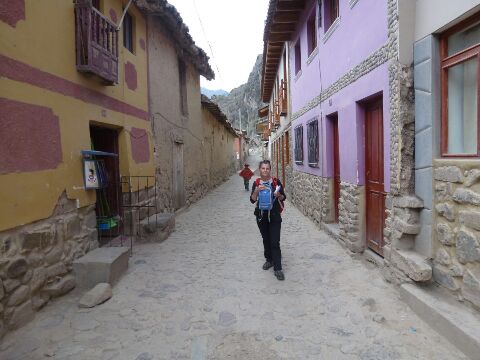
Even though this is unquestionably a tourist town, the tourists seem to come and go at predictable times of the day. Between these times life goes on much as it has for centuries. Farmers and craftswomen in traditional dress come to town to sell their goods, well-dressed school kids heading home for lunch run through the square, ignoring the odd bus or truck that crawls by and the traffic police blow their whistles for reasons that escape us, because nobody takes any notice of them. Art touts introduce themselves as Pablo Picasso or Elizabeth Taylor and if you aren't interested, they stay on for a bit of a chat and some repartee anyhow. We eventually came across Elizabeth's little studio later on the day and bought a couple of pieces.
We actually came for the Inca ruins, which were great as well, but the experience of hanging around town and meeting fellow travellers like the young French woman who fell in with us as we scrambled over the ruins, the Malaysians who lived and worked in London and several others, just over the past couple of days, who, whether they spoke English or not, made a connection that is what travel is all about.
Tomorrow we will wander back to the railway station at a time when a train is due, to take advantage of the numbers of collectivos that will be there to meet the traion. Then back to Cusco.
Hotel Tika Wasi, Ollantaytambo
This is a great little town. Our train arrived fairly much on time to be met by the usual scrum of taxi touts and Collectivo drivers. A Collectivo is a 15-20 seat bus that is a kind of large share taxi. They wait at points known to locals, or where tourists arrive en masse. When they fill up they take off for a location that is on a sign or just yelled out by the driver.
We weren't after a lift today because we were having a couple of nights in Ollantaytambo. Most people don't stay overnight here. It is more a quick stop on a circuit around the Sacred Valley. No surprise, but we are doing the normal circuit differently, so our timing called for two nights here. Good call!
Even though this is unquestionably a tourist town, the tourists seem to come and go at predictable times of the day. Between these times life goes on much as it has for centuries. Farmers and craftswomen in traditional dress come to town to sell their goods, well-dressed school kids heading home for lunch run through the square, ignoring the odd bus or truck that crawls by and the traffic police blow their whistles for reasons that escape us, because nobody takes any notice of them. Art touts introduce themselves as Pablo Picasso or Elizabeth Taylor and if you aren't interested, they stay on for a bit of a chat and some repartee anyhow. We eventually came across Elizabeth's little studio later on the day and bought a couple of pieces.
We actually came for the Inca ruins, which were great as well, but the experience of hanging around town and meeting fellow travellers like the young French woman who fell in with us as we scrambled over the ruins, the Malaysians who lived and worked in London and several others, just over the past couple of days, who, whether they spoke English or not, made a connection that is what travel is all about.
Tomorrow we will wander back to the railway station at a time when a train is due, to take advantage of the numbers of collectivos that will be there to meet the traion. Then back to Cusco.
Early days in Peru
10 September
Miraflores, Lima, Peru
Our first impressions of Lima were not terribly positive, but then, hitting heavy traffic through the poorest part of a city of 8.5 million people, after travelling for 24 hours, is not likely to put one in a terribly receptive mood. Hectic traffic, crowded streets and lots of dodgy-looking people just hanging about reminded us of a trip to Romania15 years ago - and not in a good way.
That was yesterday. After a good sleep and some time to walk around our neighbourhood, we became more positive. Miraflores is a wealthy suburb of Lima. Here, trendy young things exercise in the manicured parks that top the cliffs towering above the rolling Pacific surf, reminiscent of Muscle Beach in Los Angeles.
First up this morning we were treated to some sort of military ceremony in the small square right outside our apartment. The whole performance was straight out of "Moon over Parador". Set in a South American dictatorship, "Moon over Parador" parodied South American military pomp and ceremony. This morning's performance could have been the inspiration. A platoon of sharply-attired troops marched into the square as a team of city workers put the finishing touches to the lawns and gardens. The band swaggered across the busy roundabout, tuned up then sat down for a chat and a smoke.
Officers, staggering under the weight of medals and decorations, received salutes, chatted and enjoyed a smoke. The band launched into a martial tune, only to peter out after a few bars. The troops retired to their transports and left the field, to be replaced by what looked like every boy's set of toy soldiers in smart blue uniforms, webbing, sashes, swords and pillbox hats. (Think French Foreign Legion circa 1900s.)The band struck up the Peruvian national anthem, but ran out of puff again. Dignitaries in black cars with concealed flashing blue lights, cut through the constant flow of traffic delivering be-suited gents and smartly-dressed women who kissed each other and received multiple salutes, before joining the general melee. The band attempted another tune but were cut short, just as they were on a roll, by the MC who, backed by several thousand watts of speaker power, alerted anybody who could understand Spanish and was within 20kms of the square, of the significance of this monumental event. A couple of the cleaners were roused sufficiently to move away from the noise, but nobody else seemed to give a hoot.
Paul was sufficiently moved to go down to take a few photographs, but he, a couple of cleaners and a lone traffic cop, were the only ones who even seemed to notice the whole show.
The highlight of the whole ceremony was the band's rendition of the National Anthem of Peru. This must be their special show stopper number. They played and played and played. At some point the toy soldiers in blue and the special guests all launched into song. Backs were slapped, multiple salutes and kisses were exchanged, the toy soldiers marched through the roundabout traffic to the accompanyment of angry horns and blaring bus claxons and the world moved on.
We took advantage of the distraction this mass departure created to take a long walk along the cliff top parks to Larcomar, where our day was to begin with the validation of our Peru Rail tickets for the next couple of legs of our trip. Good plan but, after hanging about waiting for the office to open at 11:00am, and waiting in a queue for 30 minutes or so, we found that Peru Rail's printer was broken and they couldn't print our tickets! No drama? Well it probaly wasn't, but perhaps we weren't totally over the long flight. We were major miffed! Our good humour was quickly restored by a visit to the local tourist information booth where a very nice young lady gave us some great tips to help us get into the city using Lima's relatively new Metropolitano (Busway). We weren't going to bother with the "Metro" because the local buses were closer to us and we didn't want to pay the $3 for the smart card required to use the system. Seems the locals are most obliging to travellers. We just approached people topping up their cards and gave them the fare for our trip, they added it to their card and waved us in.
The Metro is quite efficient, if a little crowded. Brisbane could learn a lot from the way stations are laid out to prevent backup of buses in stations. Any trip on the system is only AUD$1.25 and frequency is high.
The busway cuts through some of the more modern parts of the city which are well laid out, clean and a match for anything in most cities in developed countries. These areas are of little interest to us; we were headed for the old city heart with its Spanish-style squares and colonial buildings. Central Lima didn't disappoint us. Beautifully restored public buildings and the frequently rebuilt Cathedral line the Main Square, Plaza de Armas.
Very Spanish, but with the indigenous women selling trinkets in their local costumes, there is a real South American feel to the whole scene. Pizzaro is buried in the Cathedral and there were bodies in the crypt, a must-see for us. Sadly, though Pizzaro's had previously been on display, it is no more. We had to be satifsied with a small ossuary and some unidentified open tombs.
Home late tonight for a few beers and a feed of local fish, home cooked.
11 September
Miraflores, Lima, Peru
Fancying ourselves as masters of the Metropolitano, we decided to walk the couple of kms to the station rather than wrestling with the hordes on the local buses. It all came slightly unravelled when we noticed that a whole new landscape was rushing past us as we sped along the busway. Somehow, we had jumped on an express bus that took a slightly different route. Not at all phased, we quite frequently get on the wrong train/tram/bus in our travels, we got off and headed back to the city centre. The Lima Metro is extremely cheap and very well patronised- read packed! We had to let two buses go as we back-tracked towards the city centre.
We have been a little puzzled by the small number of Western tourists in Lima. We very rarely see them on the bus and even the main tourist attractions are not heavily patronised, except by the locals. It may be because Lima has a reputation as a dangerous city, which in some areas it undoubtedly is, but a bit of common sense and the normal safety and security precautions helps avoid the dangers. We have felt safe everywhere we have been so far, even on the crowded public transport. There is a strong police and security presence everywhere in the city, with police riot squads stationed in key locations. We had to make a detour today near the main city square because the riot wagon and a squad in full kit had a street closed off ready to control a crowd that had gathered outside a government office. Nothing came of it and by the time we had completed our visit to the nearby church, the crowd had dispersed and the squad had moved on.
Richard Dreyfus ("Moon over Parador" - again) would have loved the ceremony of the Changing of the Guard at the Palacio de Gobierno, the Presidential Palace. A military brass band was entertaining the crowd with some swinging modern Latin numbers as we arrived, but as the guards entered, complete with high-kicking goose steps, the band launched into "El Condor Pasar" (think Simon and Garfunkel), followed by a medley of semi-recognisable tunes that we swear included parts of "Bolero" (think Torvill and Dean and the movie "Ten"). All this had been preceeded by the midday chimes of the Cathedral bells clanging out "Ave Maria". Truly spectacular, though at times a little incongruent.
Today we suffered through two extremely long guided tours "solo Espanole", one at the Monasterio de San Francisco, where at least there were lots of bones and skulls in the catacombs and the other at the Museum of the Inquisition, which featured ghoulish recreations of the tortures used in the actual building where the museum is housed, which interestingly, is right beside Peru's Parliament building.
English is not widely spoken in Peru, but we have had no problem communicating. As Spanish is one of the "Romantic" languages, our basic French and some Latin remembered from High School has generally got us by.
12 September
Miraflores, Lima, Peru
Many travel bloggers and commentators denigrate Lima's public transport system, but we have to give the city an encouragement award for the changes that are being implemented to tackle the city's transport problems. From our, admittedly limited, experience in getting about Lima, we have had no real difficulties in finding our way.
We have already mentioned the Metropolitano, but there is a Metro rail link as well. We haven't needed to use it, but if it is as efficient as the bus Metro, it will make a big difference when the current single line is expanded into a larger system. Most of the population of Lima earns around $250 US a month, so inexpensive transport is a must and inexpensive it is. Today we braved the old bus network, where fares are a maximum of AUD$1, with most shorter trips costing 20 cents. There are more than 600 bus routes in Lima but there are no route maps of any consequence, no timetables and, until recently, no bus stops. Once you get the hang of the system (or lack thereof), it works amazingly well. Beat-up Kombi-size vans, dilapidated mini-buses and normal suburban buses swarm throughout the city. All are privately owned and extremely competitive.
Stand on any corner and look apprehensive and if a taxi doesn't stop, a bus will swerve in your direction with its Cobrador (conductor) leaning out the door shouting destinations and major roads traversed. The city fathers have been working with the bus owners to establish a system of formal bus stops and they have been having some success. Old habits die hard however. Both the drivers and their passengers still prefer the convenience of flagging down a bus whenever they need one.
We put a fair amount of preparation into our trip today. Which colour bus, which roads it was taking, what the fare would be and where we would get off. We might have done just as well if we had stood at the nearest Paradero (BUS STOP) or on a corner and just looked lost! As with most things in developing countries, things just work, despite the appearance of absolute chaos. We hailed the bus, yelled our street destination to the Cobrador, got the nod and jumped aboard. Our guess at the fare was too high, he returned the excess and we were off. To stop the bus, the general rule is to stand up and yell "Bajada!" (Put me down here). In our case, the conductor remembered our stop and came down to tell us to get off. Total cost for both of us, AUD$1.20. At home the same distance would have cost around $8.
The reason for all this high adventure was to get ourselves to the suburb of Pueblo Libre where two great History and Archaeology museums are located - the National Anthropological, Archaeological and History Museum and the Larco Museum. While the collections of the two were similar, they provided us with a good grounding in the history and anthropology of Peru. The National Museum was particularly well laid out.
Requisite cultural intake for the day completed, we wandered out onto the chaotic Ave Bolivar, waved our arms about and out of nowhere a mini-van rattled through the traffic. Some yelling ensued, a few cents were handed over and we were on our way.
One final comment on riding the buses in Lima: Janita has been offered a seat on every bus we have entered. Great manners and, dare we say, respect for elders?
Tomorrow we take the 21 hour coach trip to Cusco, so a few comments in review on Lima are probably timely. We are cautious travellers, but by no means timid. We have been around and we have been in some dodgy places, but Lima, or least the parts we have visited, have been just fine. We never ignore security and safety warnings and all that we had read and heard about Lima had us on full alert, but it has not been a problem. There are some real no-go areas of the city, but there is nothing there to interest us anyhow. In short, Lima has been a great experience and we wonder why so many people see it as only a stopping over point on the way to Cusco. The city offers much for those willing to give it a go. It will grow on you. If you read our opening comments in this blog you'll see just how much it has grown on us.
13 September
Cruz del Sur bus Lima to Cusco
Left our Miraflores apartment this morning for the long haul, 21 + hours to Cusco. We opted for the highest class seats. They are equivalent to first class airline seats, but without the service!
We had begun to think that all the stories of how poor Peru was were an exageration. Most areas of the city itself are fairly reasonable. All that changed dramatically as we hit the shanty towns on the city's edge. Mile after mile of shacks roll over the hills as far as the eye can see. Ugly factories, whose sole purpose seems to be producing mountains of fine, beige dust out of the desert sand, line the highway. Hell on earth! The only thing we have seen come close are the townships of South Africa and they are probably even more liveable than these. The further from the city we get the worse the shanties become. Discarded building materials, packing cases and bricks obviously reclaimed from other structures are cobbled together to create some form of shelter. This could easily be the set for a Mad Max style apocolyptic movie.
14 September
Cruz del Sur bus
Cruz del Sur bus
After a fairly comfortable night, we are 16 hours into our 21 hour trip to Cuzco, delayed for some reason at roadworks high in the Andes.
We have seen them on the plains of Portugal, on the hill of the Acropolis, in Southern California, North Africa, Turkey and France and now high in the Andes, Australia's most noxious plant (when off our shores) the Eucalyptus! Amazing, thriving at this altitude.
Our record of "no-show"' for pre-arranged hotel pickups is holding up at close to 100%. It was no real loss for us this time though, as the taxi we grabbed at the Cusco bus station was half the price of the pre-arranged one.
15 September
Hotel Kenamari, Cusco
We had quiet afternoon yesterday recuperating from our long bus ride. Cusco is very much a tourist town with the usual array of T-shirt shops, travel agents and tourist restaurants lining the main square, but it is a spectacular place. The main Cathedral and Iglesia de La Compania de Jesus occupy two sides of the square with the other featuring colonades and balconies hanging from first floors. But for the very South American appearance of most of the people in the square, we could easily have been in Spain. While taking the sun and orientating ourselves in another small square, we chatted with a young Dutch couple who had campervanned all around Australia, kindred spirits. They also passed on the gleeful news that Tony Abbot had been ousted from the Prime Ministership in favour of Malcolm Turnbull. Oh happy days!
The valley in which Cusco is situated is central to both the pre and post-Columbian periods of Peru's history. Cusco lay at the cross roads of the long north-south and much shorter Inca roads that were the key to the development and prosperity of Inca civilization. Inca (Inka in Peru) civilization was less than 200 years old when the Spanish and their European culture and religion overcame it. Spanish conquest of the Andean cultures began in 1535, less than 50 years after the arrival of Christopher Columbus. The drivers of colonisation were simply gold and conversion. But it was not as easy a conquest as some might imagine. Today we staggered (literally) to the site of the original Inca fortifications, high above Cusco.
The altitude hit us immediately on this climb, but we were prepared for it and just slowed down. Nevertheless, we were sucking it in at every break. Only 20% of the site remains and the scale of that is breath-taking. Suffice to say, going down was much easier than going up. And we had the satisfaction of knowing that, of all those roaming about the site, we had climbed it, rather than taking a taxi or minbus to the top.
Early call tomorrow to catch the train to Machu Picchu.We will be back here in a few days, using Cusco as a base to explore the Sacred Valley.
17 September
Aguas Calientes
17 September
Aguas Calientes
Early start yesterday to catch the Peru Rail train from Cusco to Aguas Calientes, (Machu Picchu village). The train leaves from the small village of Poroy, about 30 minutes by cab from Cusco. We had booked the Vistadome train and it was well worth the extra dollars. The first part of the trip was through fairly dry farmland. Crops of corn, vegetables and our favourite Peruvian import, asparagus, dotted the countryside. Straw-coloured mountains, sparsely covered eith eucalyptus, towered above the narrow valley plain, then, about halfway through our 3 hour journey, thick rainforest appeared. The transition occurred within a few hundred metres. Dozens of varieties of ferns, bromeliads and scores of plants commonly found in Brisbane backyards spilled down from amazingly steep mountains.
Coming from a basically flat continent, we are always impressed with mountains. The Andes are just incredible. Forget the Swiss Alps. Sheer bumps. The Sierra Nevadas, the Rockies - no contest. These are easily the most spectacular ranges we have seen.
Refreshed after a quiet evening and a good sleep, we headed off to the bus station for the short haul to Machu Picchu. The queue for the bus being about 100m long, we had settled in for a long wait, but an attendant came along the line looking for a party of two to finish off a load. Some days it just goes your way.
The Machu Picchu site alone could pull Peru out of any financial difficulties it might be facing. Pizzaro missed the real bonanza. Tourist gold. Every day, thousands of tourists flock to Machu Picchu, by train at about $200 for the round trip fron Cusco. Then there are the park entry fees, $65 each and finally hit, $37 for the return 30 minute bus trip up the mountain! Oh, yes, plus the $2 toilet charge. Don't get us wrong, it was worth every cent! The skill and engineering expertise of the Inca is just amazing. Most attention was, of course, given to the temples and the palaces of the Inca King. Enormous rocks weighing hundreds of tonnes were shaped and fitted so that a knife blade could not fit in the join. The scale of Machu Picchu is simply staggering. Even more amazing is that the Machu Picchu ruins are only one of dozens of Inca cities in the Cusco area.
Now for a whinge. Selfie sticks! First off, why does every location visited while travelling have to become a frame for the stick owner-operator and their friends? Then, why must we extend them to their full 2m length and swing them about in narrow museum hallways, causing others to duck to avoid decapitation and blocking traffic while we arrange our hair and try out several different facial expressions? Ban the selfie-stick.
Back in Aguas Calientes by 11 am, we had a bit of time to kill before our train trip to Ollantaytambo later in the afternoon. We grabbed a balcony seat in a nice little cafe we had patronised yesterday and settled in for a slow lunch and some people watching. Our attention was immediately drawn to the main event in the little village square. It was a breast feeding competition. Yep.
Up on the stage were ten women with infants feeding away under the expert view of three or four judges armed with clipboards. All through this obviously important event, the male MC continued a patter that sounded like a soccer commentator on steroids. So exciting. We waited for well over an hour for an outcome, but in Peru, these things obviously need serious consideration. We felt we had to abandon our balcony seats for other diners who may or may not have a great interest in the outcome of this extravaganza.
Subscribe to:
Posts (Atom)